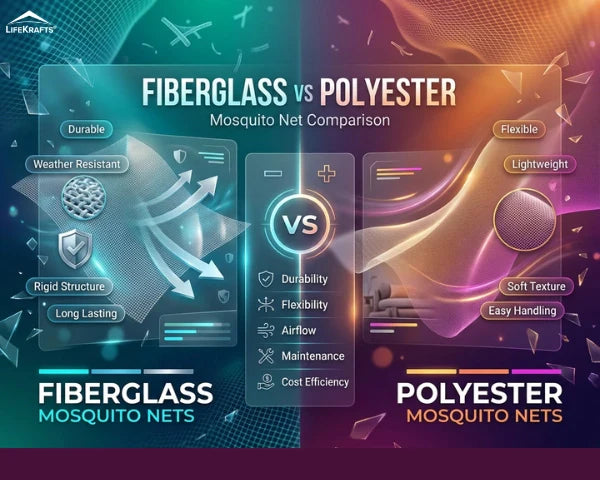
Fiberglass vs Polyester Mosquito Nets: Comparison
India's mosquito menace continues to grow in 2026, with dengue cases on a sustained upward trend — surpassing 230,000 nationally in 2024 and projected to rise further. Urban hubs like Bengaluru and Mumbai remain established hotspots, driven by monsoon climate patterns. Mosquito nets are a recommended line of defense, with insecticide-treated options being the standard health guidance, though the choice between fiberglass and polyester involves trade-offs in durability, airflow, and cost.
Why 2026 Redefines Mosquito Net Choices
Rising health awareness drives India's mosquito net Brand and their markets towards more effective and durable protective options.
Core Material Breakdowns
Fiberglass Mosquito Nets: Built for Extremes
Fiberglass mosquito nets are a durable choice for India's coastal and high-humidity regions. Their rigid weave structure maintains shape and resists sagging under prolonged moisture exposure — an advantage over softer materials in monsoon-heavy areas. Fiberglass is a Chemical corrosion resistance, making it a safer long-term option for urban households. Minimum weave of 18*16 Weave(Apertures/Square Inch) is recommended. Commonly used fiberglass nets are fiberglass door nets and fiberglass window nets.
Hidden 2026 Edge: Antimicrobial Coatings
Certain fiberglass nets feature silver-ion antimicrobial coatings that help reduce bacterial and mold buildup over time — particularly beneficial in India's post-monsoon humidity. This extends the net's hygienic lifespan without chemical retreatment.
Fresh Trait: Eco-Recyclability Push
Nets manufactured from recycled materials are an emerging and responsible choice, supporting India's national sustainability goals. Opting for recyclable or recycled-content nets reduces long-term environmental impact without compromising protection standards.
Polyester Mosquito Nets: Affordable Flexibility
Polyester nets provide reliable, budget-friendly protection with good breathability and airflow — important for comfort in India's warm climate. Their moisture-wicking properties help prevent mold growth in high-humidity cities like Mumbai and Bengaluru. For long-term use, polyester nets meeting WHO's 156 holes/cm² mesh standard offer consistent and effective protection against mosquito-borne diseases.
2026 Novelty: Smart Zipper Integrations
Zippered polyester nets, including those made from recycled PET, offer a practical and flexible installation solution. Easy to fit and remove without permanent fixtures, they are particularly suitable for renters and urban apartment dwellers seeking long-term, damage-free mosquito protection.
Installation Insights for Indian Homes
Renter-Friendly DIY Options
Magnetic polyester mesh screens are available across India at ₹100–₹5,400, offering tool-free installation via adhesive Velcro strips — making them a practical choice for renters or anyone who prefers not to alter walls permanently. Window nets, Door nets, Bed nets and Baby nets are the commonly classified for nets.
Explore this article for how the window mosquito nets can be an climate smart protection with detailed informations.
Choosing the Right Mosquito Net for Indian Homes
By the protection area
Polyester nets are a cost-effective option for urban homes, requiring minimal maintenance, with more lifespan. Fiberglass nets are better suited for coastal and high-humidity regions due to superior moisture resistance, with more lifespan.
Windows
Window mosquito nets are a core preventive strategy for Indian homes, particularly important for children, the elderly, and pregnant women in multi-generational households. Fixed frame, sliding, and adhesive-tape types are available.
Materials: fiberglass (120 GSM) or polyester, recommended for humid/coastal areas .
Bed / Sleeping Area
Mosquito nets are most commonly used as tent-like coverings over a bed or sleeping area, offering barrier protection against mosquito-borne diseases including malaria, dengue fever, and chikungunya. Rectangular nets are preferred as they provide more room without the netting contacting skin, through which mosquitoes can bite. Hanging/canopy nets, and pop-up nets. Material: polyester.
Doors
Door mosquito nets are suitable for main doors, back doors, and balcony doors. Options include single, double, foldable, and magnetic auto-close curtain types, with mesh allowing clear vision while protecting living spaces from mosquitoes and insects.
By Material & Climate
Polyester nets are an cost-effective option, requiring minimal maintenance, with more lifespan. Fiberglass nets are better suited for coastal and high-humidity regions due to superior moisture resistance, with more lifespan.
On Certification
Always look for the ISI Mark under BIS Standard IS 16513:2016, which is the mandatory official Indian standard for insect/mosquito nets covering safety, durability, and performance. Purchasing from BIS-certified suppliers is legally required and ensures product quality.
Frequently Asked Questions
1. Which material offers better protection against mosquitoes – fiberglass or polyester?
Fiberglass nets offer more consistent protection because the rigid mesh maintains uniform gap sizes and doesn't sag or deform over time and the Polyester nets can provide comparable protection when new, but their flexible weave may loosen with use, potentially allowing small insects through.
2. Can fiberglass or polyester nets be used on doors, not just windows?
Yes, both can be used on doors, but the approach differs. Fiberglass mesh is ideal for fixed screen doors mounted in a rigid aluminum or wooden frame — it holds its shape under repeated opening and closing. Polyester is better suited for magnetic screen doors (the split-panel type with magnets that snap shut), retractable door curtain nets, or temporary hook-and-loop installations.
3. Can polyester mosquito nets be treated with insecticide (like permethrin)
Yes — polyester is the preferred material for insecticide-treated nets (ITNs). The synthetic fibers absorb and retain permethrin or deltamethrin effectively, and the treatment can last through multiple washes. WHO-recommended long-lasting insecticidal nets (LLINs) are almost exclusively made of polyester.
4. Is fiberglass safe to handle? Can it cause skin irritation?
Fiberglass net material, when properly manufactured into screen mesh, is generally safe for everyday contact. Always wear gloves when cutting or installing fiberglass mesh, and avoid rubbing your eyes. Once installed in a frame, it poses no ongoing risk.
5. Which net type is better suited for hot and humid climates like those in south Asia?
For hot, humid regions like India, both materials are used but for different purposes. Fiberglass window screens are excellent for fixed installations — they resist warping in heat and don't absorb moisture. Polyester bed nets are widely preferred for sleeping areas due to their softness, lighter weight, and compatibility with insecticide treatment.

Written by LifeKrafts Admin